150 Cute Kawaii Food Coloring Pages: A Practical Evaluation for Creators and Educators
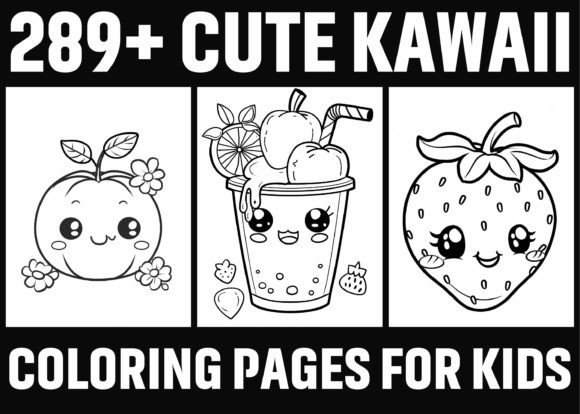
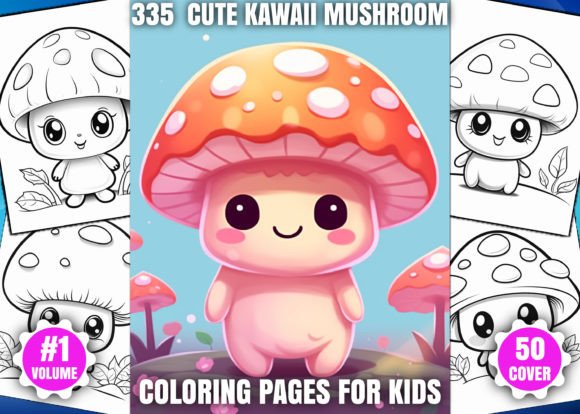
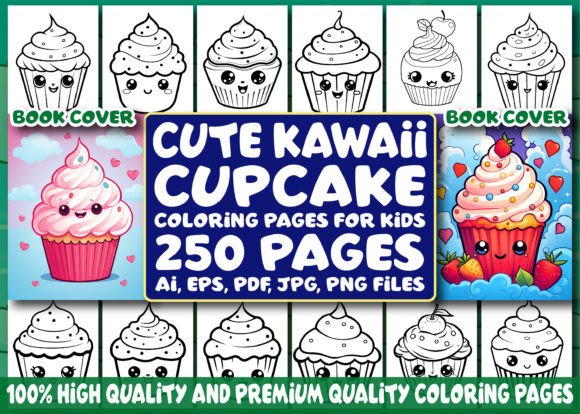
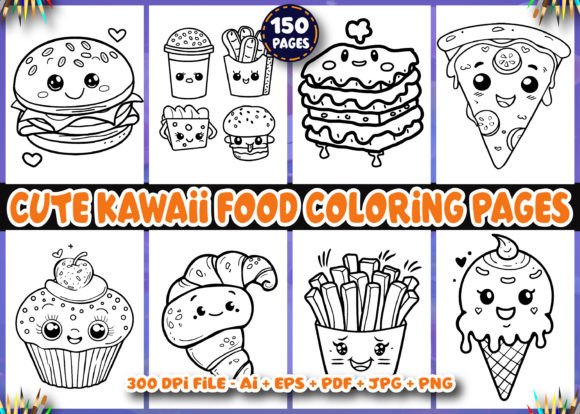
150 Cute Kawaii Food Coloring Pages is a digital printable bundle designed for creators, educators, parents, and small publishers seeking ready-to-use, high-quality coloring content with strong visual appeal and commercial flexibility. Unlike generic food-themed coloring sheets, this collection centers on the kawaii aesthetic—characterized by soft lines, rounded shapes, expressive faces, and playful charm—applied specifically to everyday foods like cupcakes, bento boxes, sushi rolls, fruit slices, milkshakes, and ice cream cones. The result is a cohesive set of 150 original illustrations that balance child-friendly simplicity with stylistic consistency and print readiness.
What Sets This Bundle Apart From Other Coloring Resources
Several practical features distinguish 150 Cute Kawaii Food Coloring Pages from broader or less specialized offerings. First, it delivers multiple file formats in one package: editable .ai and .eps files for designers who need to adjust line weight, crop layouts, or integrate pages into larger projects; production-ready .pdf files formatted to A4 (8.5″ × 11″) at 300 DPI; plus individual .jpg and .png files—also at 300 DPI—ideal for digital use, social media previews, or hybrid publishing workflows. Few comparable bundles provide this level of format diversity without requiring separate purchases or conversions.
Second, the interior pages are strictly black-and-white line art—no grayscale shading or background textures—which ensures clean, predictable printing on standard home or commercial printers. That’s especially important for Amazon KDP users, where inconsistent grayscale rendering can trigger quality rejections or cause customer complaints about faint lines. Third, the kawaii food theme avoids overused tropes (e.g., cartoon animals or fantasy characters), offering a niche yet broadly accessible subject that resonates with both children and adult colorists interested in Japanese-inspired design.
How It Compares With Alternative Approaches
When evaluating options for coloring book creation, creators typically consider three main paths: sourcing royalty-free clipart, commissioning custom illustrations, or purchasing curated digital bundles like 150 Cute Kawaii Food Coloring Pages. Each has tradeoffs.
- Royalty-free clipart libraries offer variety but rarely deliver thematic cohesion or consistent line quality across hundreds of images. Users often spend hours filtering, resizing, and adjusting contrast—time that adds up when preparing 150+ pages for print.
- Custom illustration commissions allow full creative control and brand alignment but carry higher cost (often $5–$15 per page at scale), longer lead times, and require clear briefs and revision management—barriers for solo creators launching their first KDP title.
- Digital bundles like 150 Cute Kawaii Food Coloring Pages sit between those extremes: they offer professional-grade output without the overhead of hiring or the fragmentation of clipart. The fixed scope (150 pages) also provides realistic expectations—no “hundreds of designs” ambiguity common in vague stock descriptions.
This makes 150 Cute Kawaii Food Coloring Pages particularly suitable for creators aiming to publish a single, focused title quickly—say, a themed coloring book for ages 4–8—or for educators building classroom activity packets centered on nutrition, food groups, or Japanese culture units.
Realistic Use Cases and Fit Considerations
The bundle works best when used as intended: as interior content for printed or digital coloring books, classroom handouts, party activity sheets, or supplemental materials in early childhood education settings. Its A4 sizing and 300 DPI resolution align directly with Amazon KDP’s interior requirements, eliminating guesswork around bleed, margins, or pixelation. For example, a creator launching a “Kawaii Bento Box Coloring Book” could use 30–40 pages from the set as core interiors, then add original cover art, a simple introduction page, and age-appropriate instructions—all within KDP’s free interior template system.
It’s less ideal for users needing extensive customization beyond line art—such as adding bilingual text overlays, interactive elements (e.g., QR codes linking to food facts), or complex layered backgrounds. While the .ai and .eps files support vector edits, they don’t include pre-built text boxes or layered composition guides. Similarly, educators seeking differentiated versions (e.g., simplified outlines for younger learners or challenge variations with hidden objects) would need to adapt pages manually—something possible, but not built-in.
Strengths, Limitations, and Decision Factors
Among its strengths, 150 Cute Kawaii Food Coloring Pages offers reliable technical execution: consistent line weight, balanced negative space for coloring, and intentional spacing around each food item to avoid crowding. The kawaii treatment avoids overly childish simplification—many pages include subtle details like sprinkles, steam curls, or patterned chopsticks—that engage developing fine motor skills without overwhelming beginners.
Limitations are mostly contextual rather than functional. Because all pages follow the same aesthetic and size, the bundle doesn’t include alternate layouts (e.g., full-page scenes vs. grouped icons), seasonal variations (like Halloween-themed kawaii candy), or progressive difficulty levels. It also lacks instructional or pedagogical scaffolding—there’s no curriculum guide, vocabulary list, or discussion prompts included. That’s not a flaw in the product itself, but an important fit consideration: if your goal includes teaching food literacy or integrating SEL concepts, you’ll need to layer those elements separately.
Decision factors worth weighing include:
- Time sensitivity: If you need to go from concept to published KDP book in under two weeks, this bundle reduces prep time significantly compared to building from scratch.
- Design confidence: Users comfortable with basic PDF assembly or Canva/KDP templates will find the ready-made pages easier to implement than raw vectors requiring Illustrator expertise.
- Target audience alignment: Children aged 4–8 respond well to the friendly, non-intimidating food depictions—but older kids or teens may prefer more intricate patterns or stylized realism, which this bundle doesn’t emphasize.
Final Thoughts for Informed Selection
150 Cute Kawaii Food Coloring Pages isn’t a universal solution, nor is it meant to replace thoughtful curriculum design or long-term brand development. Instead, it serves as a high-fidelity, production-ready foundation—a tool that removes friction from the early stages of content creation. Its value lies in reliability: knowing every page meets print standards, fits a defined aesthetic, and supports common distribution channels like Amazon KDP without licensing ambiguity.
For creators comparing resources, it’s worth asking not just “Does this meet my technical needs?” but “Does this align with how I plan to use it—and what I’ll need to add next?” If your workflow benefits from consistency, speed, and clarity—and if kawaii food resonates with your intended audience—150 Cute Kawaii Food Coloring Pages stands out as a pragmatic, well-executed option among available digital coloring assets.