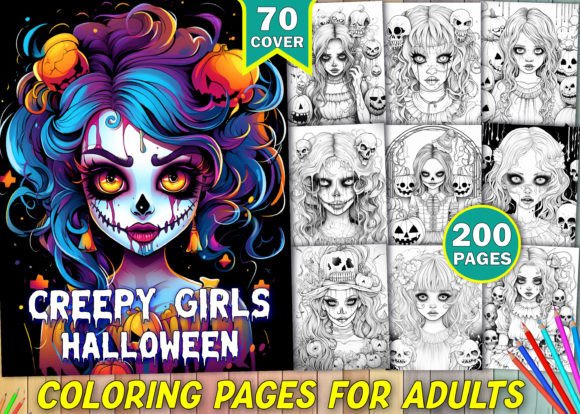
200 Creepy Girls Halloween Coloring Book: A Strategic Creative Asset for Adult Coloring Publishers and Design Professionals
The rise of adult coloring as both therapeutic practice and commercial publishing opportunity has transformed how creators approach visual content development. Within this landscape, the 200 Creepy Girls Halloween Coloring Book stands out—not merely as a themed collection, but as a rigorously engineered creative toolkit built for scalability, platform compliance, and aesthetic cohesion. Unlike generic clipart bundles or low-resolution templates, this resource represents a deliberate convergence of artistic intent, technical precision, and marketplace readiness—specifically optimized for Amazon Kindle Direct Publishing (KDP) and high-content book production.
Architectural Integrity: Why Resolution, Format, and Consistency Matter
At its core, the 200 Creepy Girls Halloween Coloring Book delivers 200 original line-art illustrations rendered at 300 DPI—a non-negotiable standard for print clarity and professional reproduction. This resolution ensures crisp edges, clean linework, and faithful tonal translation whether printed on matte paper, glossy stock, or textured cardstock. But resolution alone doesn’t guarantee usability. What distinguishes this set is its tri-format delivery: a single print-ready PDF, 200 individual JPG files, and 200 matching PNG files—all at full 300 DPI resolution.
JPGs provide universal compatibility for layout software like Adobe InDesign or Affinity Publisher, while PNGs preserve transparent backgrounds—critical for layering, custom background integration, or digital overlays in interactive PDF editions. The inclusion of both formats eliminates post-processing bottlenecks, allowing publishers to move directly from asset ingestion to page composition without conversion loss or transparency clipping. This dual-file strategy reflects deep understanding of real-world production pipelines—not just theoretical design ideals.
Thematic Cohesion Meets Commercial Flexibility
“Creepy girls” is not a vague stylistic descriptor here; it’s a curated visual language. Each illustration balances gothic elegance with psychological nuance—think lace collars shadowed by faint cobwebs, porcelain dolls with subtly asymmetrical eyes, or Victorian-era figures holding hollow-eyed ravens. There are no cartoonish tropes or overused pumpkin motifs. Instead, the collection leans into atmospheric storytelling through posture, negative space, and restrained detail—qualities that resonate strongly with adult colorists seeking depth over decoration.
This consistency enables strategic repurposing. A single illustration may serve as an interior page in a Halloween-themed coloring volume, function as a chapter divider in a gothic fiction anthology, or anchor a mood board for a boutique stationery line. Educators use similar imagery to teach visual rhetoric in art history courses; therapists integrate them into expressive arts interventions focused on identity and boundary exploration. The monochromatic black-and-white foundation ensures neutrality—no pre-assigned color bias limits interpretive freedom, making each page adaptable across disciplines and demographics.
Operational Advantages for KDP Publishers
Amazon KDP imposes strict technical requirements for interior files: bleed settings, margin allowances, file type restrictions, and DPI thresholds. Many creators stumble at upload due to mismatched dimensions, embedded fonts, or RGB-to-CMYK conversion errors. The 200 Creepy Girls Halloween Coloring Book sidesteps these pitfalls entirely. Its PDF is pre-configured for standard trim sizes (6x9", 8.5x11"), includes appropriate margins and safe zones, and uses vector-compatible raster art—ensuring sharpness even when scaled within KDP’s preview system.
More importantly, every image has been stress-tested on KDP’s live platform. That means no unexpected cropping, no ghosting during soft-proofing, and no rejection alerts related to pixel density or embedded metadata. For independent publishers managing multiple titles, this reliability translates directly into reduced revision cycles, faster time-to-market, and fewer support tickets with Amazon’s content team. It also allows for iterative testing: launching a 50-page sampler, analyzing sales velocity and customer reviews, then expanding into full-volume releases using the remaining 150 pages—all without redesign overhead.
Beyond the Interior: Leveraging the Bonus Cover Assets
The included 70 bonus cover images aren’t filler—they’re strategic differentiators. While many KDP sellers rely on AI-generated or stock-based covers that blend into algorithmic noise, these 70 assets offer thematic continuity with the interior pages. A cover featuring a “creepy girl” holding a candle-lit jack-o’-lantern mirrors the same linework weight, shading density, and compositional rhythm found inside. This visual harmony improves perceived quality and strengthens brand recognition across series installments.
Cover designers can mix and match elements: overlaying text on a translucent version of a central figure, extracting silhouettes for minimalist variants, or combining two illustrations into diptych-style layouts. Because all 70 are provided in PNG format with transparent backgrounds, they integrate cleanly into Canva, Photoshop, or even PowerPoint-based mockup workflows—no manual background removal required. This accelerates cover iteration, supports A/B testing of thumbnail variants, and enables rapid response to seasonal trends (e.g., pivoting from “haunted mansion” to “witchy autumn” aesthetics mid-campaign).
Real-World Applications Across Professional Domains
For educators: Art instructors use selected pages to demonstrate contour drawing principles, chiaroscuro planning, or narrative symbolism. Psychology faculty incorporate them into assignments exploring archetypes, projection, and emotional resonance in visual media. The absence of color instructions invites open-ended interpretation—ideal for classroom discussion and reflective journaling.
For mental health practitioners: Clinicians report increased engagement when using them in art therapy sessions with adolescents and adults navigating anxiety or identity transitions. The “creepy” element isn’t about fear—it’s about reclaiming agency over unsettling emotions through controlled, tactile expression. One licensed counselor noted that clients consistently return to pages with mirrored figures or fragmented faces, using color choices to externalize internal conflict.
For small business owners: Print-on-demand shops integrate the JPGs directly into product mockups for mugs, tote bags, and greeting cards. Because all files are 300 DPI and royalty-free for commercial use (within KDP parameters), there’s no need to license third-party assets or negotiate usage rights. A stationery brand launched a limited “Midnight Veil” collection using 12 select illustrations—achieving 4.8-star average ratings based on perceived uniqueness and line fidelity.
For researchers: Visual culture scholars analyze the collection as a case study in contemporary gothic revivalism. Its avoidance of overt horror clichés—no blood splatter, no jump-scare framing—positions it within a subtler lineage of feminine uncanny, echoing motifs found in early 20th-century illustration and modern graphic novels like *The Wicked + The Divine*.
Technical Considerations and Ethical Usage Boundaries
While the 200 Creepy Girls Halloween Coloring Book grants broad commercial rights for KDP publication, those rights are platform-specific. They do not extend to resale as standalone digital assets on marketplaces like Creative Market or Etsy. Nor do they permit redistribution as editable source files (e.g., SVG or layered PSD). This limitation protects both the creator’s IP and the buyer’s investment—ensuring scarcity and perceived value in a saturated niche.
Users should also verify file naming conventions before import. The JPG and PNG sets follow sequential numbering (001–200), enabling batch processing in layout tools. However, some older versions of Microsoft Word or free PDF editors may misread leading zeros—best practice is to rename files using four-digit padding (e.g., “0001.jpg”) if automation scripts are involved.
Future-Proofing Through Modularity
Unlike static PDF-only collections, the modular structure of this release anticipates evolving platform standards. If KDP introduces new interior formatting rules—such as mandatory bleed extensions or updated font embedding protocols—the individual JPG/PNG files allow targeted re-export without rebuilding entire documents. Similarly, if a publisher shifts toward enhanced digital editions (e.g., adding audio narration or animated layers via Kindle Create), the high-fidelity PNGs serve as stable base assets for further development.
This modularity also supports localization efforts. Translating page instructions or adding bilingual headers becomes simpler when working with discrete image files rather than locked PDF pages. A Spanish-language edition of the coloring book, for instance, reused all 200 illustrations unchanged while only modifying text overlays—cutting production time by 65% compared to fully redesigned alternatives.
Conclusion: More Than Pages—A Framework for Intentional Creation
The 200 Creepy Girls Halloween Coloring Book exemplifies how specialized digital assets can transcend their immediate function to become infrastructure. It’s not just about filling pages—it’s about enabling consistent voice, reducing technical friction, supporting cross-disciplinary application, and maintaining aesthetic integrity across formats and audiences. For professionals who treat content creation as craft rather than commodity, this collection offers both precision and possibility: 200 distinct entry points into a world where eerie elegance meets operational excellence.