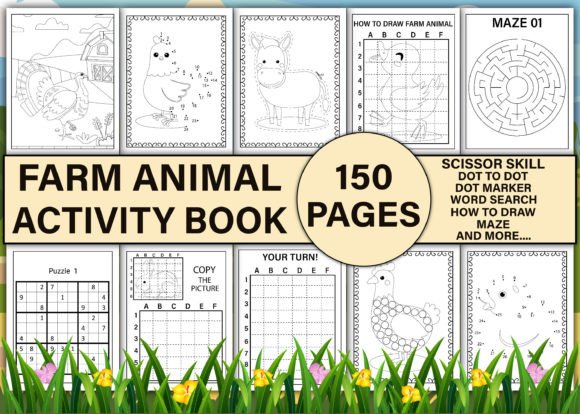
Farm Animal Activity Book Vol-1
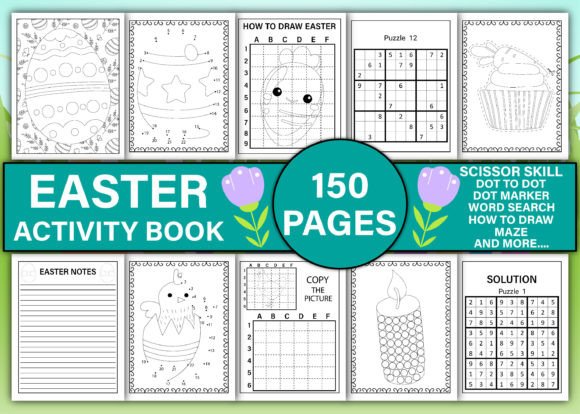
If you're building a high-content children’s activity book business—or scaling your KDP, Etsy, or print-on-demand catalog—Farm Animal Activity Book Vol-1 isn’t just another interior pack. It’s a production-ready, designer-grade toolkit built for speed, flexibility, and real-world usability. With 150 unique, A4-sized (8.5″ × 11″) pages—each with full bleed and high-resolution output—you get more than filler content. You get intentional variety: dot-to-dot sequences that build number fluency, dot marker pages that strengthen fine motor control, scissor skills layouts calibrated for early cutting practice, coloring pages with bold outlines and thoughtful negative space, step-by-step “How to Draw” guides, mazes that scaffold problem-solving, copy-the-picture exercises for visual memory, and concise Farm Animal Notes that support early science literacy.
What sets this apart from generic clipart bundles is its cohesive visual personality. The line work is clean but warm—not sterile vector perfection, not overly sketchy. It strikes a balance between educational clarity and childlike charm. Animals are expressive without being cartoonish; proportions are accurate enough for learning, yet friendly enough to hold attention. The style reads as both timeless and contemporary—no dated gradients or overused textures. It’s designed to sit comfortably beside premium publishers’ work, not mimic low-cost PDF marketplaces.
Why This Interior Works Across Print & Digital Workflows
This isn’t just “printable PDFs.” It’s a layered production system. You receive AI source files—fully editable vectors—so you can adjust line weight, recolor elements, resize components without pixelation, or isolate parts for custom layouts. The 150 PNGs and 150 JPGs give you instant drag-and-drop flexibility for social media previews, email banners, or website mockups. And because every file is sized to A4 with bleed, you avoid last-minute cropping surprises when prepping for KDP or local print shops.
Designers appreciate the consistency in stroke rhythm and spacing across page types. That uniformity means your book feels professionally curated—not stitched together from mismatched assets. For marketers and content creators, that cohesion translates directly into perceived value: readers (and their parents) subconsciously register polish, reliability, and intentionality. It’s the difference between “another activity book” and “the one I keep on my shelf.”
Real-World Use Cases Beyond KDP
Yes, Farm Animal Activity Book Vol-1 is KDP-optimized—but its utility stretches far beyond Amazon. Bloggers use individual pages as lead magnets: “Download our free farm animal maze!” Crafters repurpose dot marker sheets as templates for embroidery transfers or sticker-making. Small business owners integrate pages into summer camp packets, preschool newsletters, or library storytime kits. Educators adapt the “Farm Animal Notes” section into flashcards or classroom posters—especially since each note includes simple facts (habitat, diet, baby name) written at a Grade 1–2 reading level.
For brand strategists and product developers, this interior serves as a modular foundation. Swap out one “How to Draw” page for a branded version with your logo watermark. Layer a custom cover over the included interiors and launch a themed series—“Vol-2: Ocean Animals,” “Vol-3: Forest Friends”—using the same visual language. That kind of scalability matters when you’re testing niches or building a recognizable line.
Editing, Customizing, and Maintaining Quality
The AI files aren’t just editable—they’re intelligently layered. Animal outlines sit on one layer; background elements on another; text placeholders (where applicable) on a third. That means resizing a cow illustration won’t distort the grass beneath it. You can change colors globally using swatches, or locally using the Direct Selection Tool—no need to retrace paths. And because all 150 pages share the same artboard dimensions and bleed settings, batch exporting for print or web is seamless.
When resizing for different formats—say, adapting A4 pages to Letter size for US-based printers—maintain aspect ratio and check critical margins manually. Some mazes or dot-to-dot sequences rely on precise spacing; shrinking too aggressively can make paths illegible or dots too close. Always soft-proof in grayscale first: what looks distinct in color may blur when photocopied or printed on lower-end devices.
Licensing, Commercial Use, and Practical Next Steps
This is a commercial-use package—no attribution required, no per-unit fees. You own the right to publish, sell, and distribute physical and digital versions of books built from these interiors. That includes selling printed copies via Shopify, bundling with online courses, or licensing to schools (though reselling the raw files themselves remains prohibited). Always verify your platform’s specific requirements: KDP accepts AI files only as final PDF exports, while some POD services require flattened JPGs with embedded fonts.
Before launching, test three things: First, print a sample spread on your target paper stock—matte vs. glossy affects marker bleed and crayon grip. Second, run one maze and one dot-to-dot through a parent or teacher beta group. Watch where they pause or ask questions—those are subtle cues about pacing and clarity. Third, cross-check your chosen font pairings. If you’re adding titles or instructions, choose a clean sans serif (like Montserrat or Open Sans) for headings and a slightly rounded, legible sans for body text—nothing overly decorative that competes with the illustrations.
Farm Animal Activity Book Vol-1 succeeds because it respects both the child learner and the adult creator. It doesn’t assume you’re a graphic designer—but it gives you the tools a designer would expect. It doesn’t talk down to kids—but it never forgets that engagement starts with clarity, consistency, and quiet confidence in the craft.