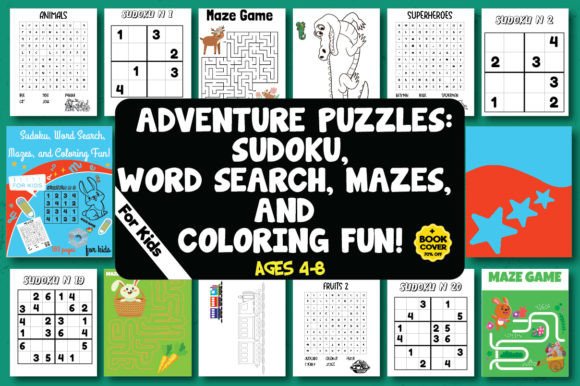
Sudoku, Word Search, Mazes, and Coloring: A Practical Guide for Early Learning Activity Books
For caregivers, educators, and publishers evaluating activity books for children aged 4 to 6, Sudoku, Word Search, Mazes, and Coloring represent four foundational puzzle types with distinct cognitive and developmental roles. Each supports early learning in measurable ways—but their effectiveness depends on design, age alignment, and intended use.
What These Activities Are—and What They Support
Sudoku (early versions) for this age group typically uses symbols or numbers 1–4 or 1–6 in small grids (e.g., 4×4). It introduces pattern recognition, one-to-one correspondence, and simple deductive reasoning—building blocks for later math and logic skills. Unlike adult Sudoku, these versions emphasize visual matching and repetition over complex inference.
Word Search puzzles at this level feature short, high-frequency words (e.g., “cat,” “sun,” “red”) embedded in a 6×6 or 8×8 grid with clear letter spacing. They reinforce letter identification, phonemic awareness, and early vocabulary recall—not spelling mastery, but exposure and recognition in context.
Mazes range from single-path tracing exercises to multi-choice branching layouts. Well-designed mazes require sustained attention, hand-eye coordination, and sequential planning. For ages 4–6, the most effective mazes avoid dead ends that cause frustration and instead guide progressive decision-making within manageable spatial boundaries.
Coloring pages included alongside puzzles serve dual functions: they offer motor skill practice (grip, control, pressure modulation) and provide cognitive downtime between structured tasks. Thematic, line-art illustrations—especially those tied to the puzzle themes—support narrative thinking and emotional engagement without requiring reading fluency.
Why Someone Might Choose This Combination
This blend responds to several practical needs. First, it offers variety without overload: rotating between logic (Sudoku), language (Word Search), spatial reasoning (Mazes), and creative expression (Coloring) aligns with young children’s short attention spans and diverse learning preferences. Second, it supports screen-free engagement. With no digital component required, it suits environments where device use is limited—classrooms with shared resources, travel, quiet time, or homes prioritizing tactile learning.
Third, the format—1 puzzle per page, large print, consistent layout—reduces visual clutter and supports independent navigation for emerging readers and pre-writers. That structure also simplifies printing, binding, and adaptation for print-on-demand platforms like KDP.
Benefits, Tradeoffs, and Realistic Expectations
The primary benefit is integrated skill reinforcement. A child may count symbols in Sudoku, identify letters in Word Search, trace paths in Mazes, and name colors while coloring—all within one session. Research suggests such multimodal engagement strengthens neural connections across domains, especially when themes (e.g., animals, weather, vehicles) link activities meaningfully.
However, tradeoffs exist. Sudoku for ages 4–6 requires careful scaffolding. Grids that are too large or rules too abstract can lead to disengagement—not because the child lacks ability, but because the task exceeds working memory capacity. Similarly, Word Search lists must match known vocabulary; including unfamiliar words without support (e.g., pictures, definitions) turns practice into guessing.
Mazes that rely heavily on fine motor precision may frustrate children still developing pencil control. And coloring pages, while beneficial, contribute little to academic readiness unless paired intentionally—for example, labeling parts of a drawn tree after coloring, or counting objects in the scene.
Expectations should be developmentally grounded: improvement in focus duration, increased willingness to attempt novel tasks, and gradual growth in symbol recognition—not immediate mastery of logic or spelling.
When This Format Is a Strong Fit
This combination works well in settings where consistency, portability, and low setup are priorities. Examples include:
- Travel or waiting situations—a printed book requires no charging, Wi-Fi, or app installation.
- Classroom centers or homeschool routines—the 1-per-page layout allows easy assignment, rotation, and assessment of individual progress.
- Therapeutic or inclusive contexts—large print and uncluttered pages accommodate visual processing differences, while varied activity types let children self-select based on energy or mood.
- Self-publishing or small-batch production—print-ready PDFs with standard dimensions (8.5×11 inch) and high-resolution interiors reduce formatting hurdles for POD platforms.
When Alternatives May Be Worth Considering
If the goal is targeted skill acceleration—such as rapid vocabulary expansion or handwriting fluency—a dedicated resource (e.g., flashcards with audio support, guided tracing workbooks) may yield more focused practice than a mixed-format book.
If interactivity or feedback is essential, digital tools—with adaptive difficulty, instant correction, and speech modeling—offer advantages that static pages cannot replicate. Likewise, for children with significant motor challenges, manipulative-based alternatives (e.g., magnetic mazes, tactile word tiles) may better support access.
Finally, if thematic depth matters more than variety, a story-driven activity book—where puzzles emerge organically from a narrative arc—may sustain engagement longer than isolated, standalone pages, even if total page count is lower.
Making an Informed Choice
Evaluating a book built around Sudoku, Word Search, Mazes, and Coloring means looking beyond page count (e.g., 163 pages) or features like “large print” and asking: How are difficulty levels calibrated across sections? Are themes repeated meaningfully to reinforce concepts? Is there space for response or extension—or is completion the only goal?
Review sample pages for consistency in font size, line weight, and visual hierarchy. Check whether Word Search words appear in the accompanying coloring illustration (supporting cross-modal learning) or whether maze solutions build toward a reveal (adding narrative payoff). For publishers, verify file compatibility—PDF, EPS, and AI formats enable both printing and future redesign, while PNG/JPG exports suit marketing thumbnails but not scalable production.
In summary, this puzzle combination is neither universally optimal nor inherently limited. Its value emerges from intentional design aligned with developmental realities—not novelty or volume. When matched thoughtfully to a child’s current abilities and a caregiver’s practical constraints, it offers quiet, accessible, and genuinely supportive learning time—one page, one path, one word, one color at a time.